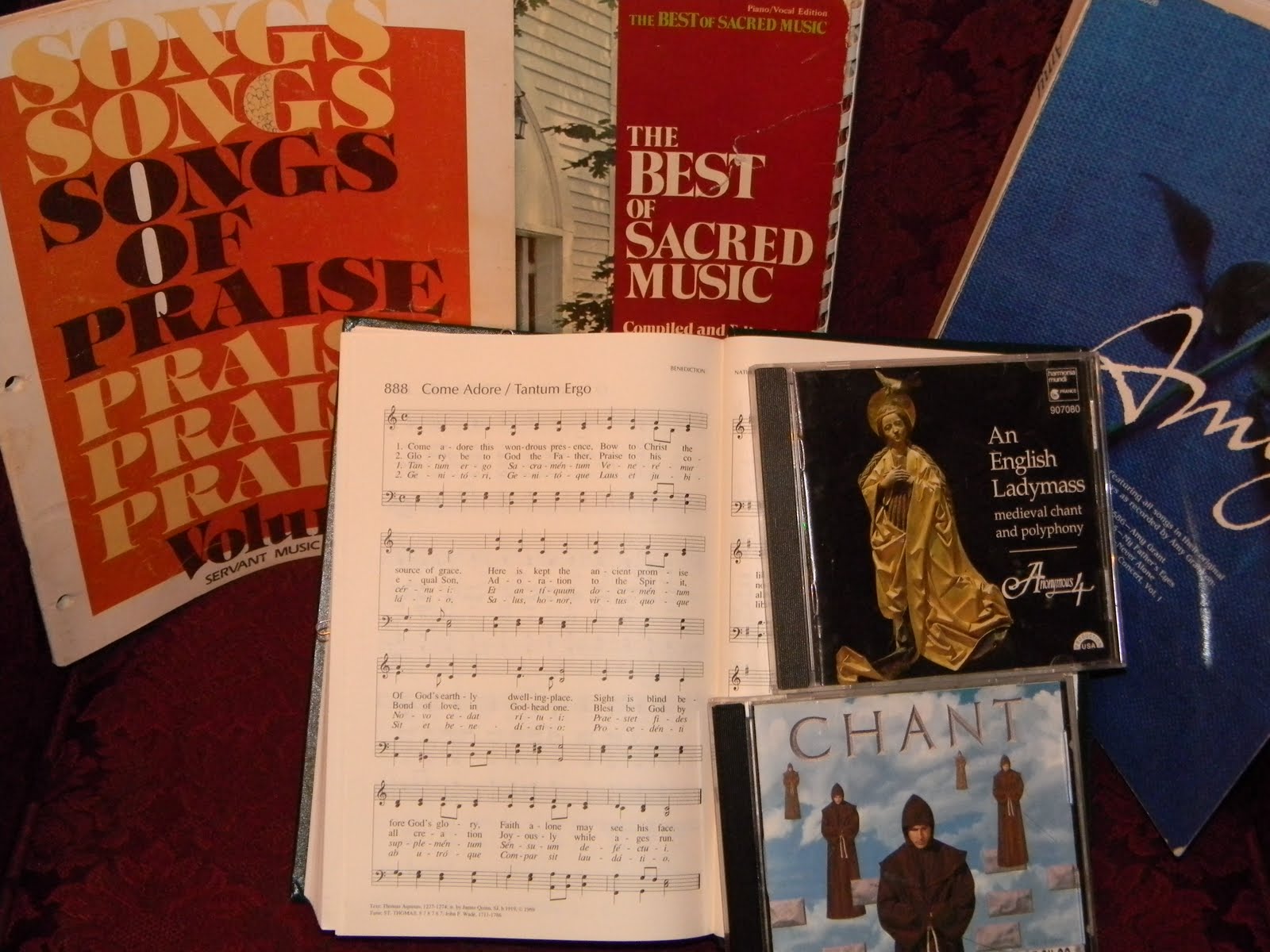
We are on a countdown in the Catholic Church. On Sunday, November 27, 2011 the season of Advent will begin, and along with it will come changes to the Catholic liturgy. We have been familiar with this form of the liturgy for over 30 years - a lifetime for many of us. So, what is this all about?
First - what? The changes actually already happened, in Latin. The liturgy is revised every so often in order to update the list of saints and feasts days. In 2000, the Jubilee year, Bl. John Paul II announced a new revision of the liturgy was in order. The Roman Missal (3rd edition) was finished in 2002. Once the Roman Missal, which is in Latin, is released it becomes necessary to translate into the various languages for use around the world.
Now, anyone who has taken a foreign language can tell you that translating is a tricky business. A word can have more than one meaning, or there can be shades of variation in a word.
For example, in English, the word - "happy". Happy can be happy, but it might also be "joyful", "glad", "ecstatic", "giddy", and so on. Each word has a slightly different flavor to it. If one is translating into English, you would have to pick the word that best describes what kind of "happy" you mean. One translator may choose "happy" while another choose "ecstatic". So you might have:
- The new puppy made the children happy.
- The new puppy made the children ecstatic.
Back to the liturgy ....
As the theologians, translators, and bishops began to look at putting the 3rd edition of the Roman Missal into English, it became more and more clear that the liturgy we are all so familiar with had been rather loosely translated at some sections. This called for a deeper look at each word in the liturgy, and a decision to return to a more faithful, if formal, translation.
This translation will debut the first Sunday of Advent, 2011. However, many parishes are now putting things in motion. Choirs are learning new or revised mass settings, DRE's are preparing to educate the congregation, and the pastor is getting ready to ruffle some feathers! Uh, I mean, the pastor in getting ready to present it all to a congregation.
That was the what, now for the WHY.
Why are we doing this? I have already been hearing grumbles from the pews. In reality, it is a great question. Why?
Does it REALLY matter if we say "And also with you" versus "And with your spirit"? Is God going to, shall we say, get His panties in a bunch if we translate "Sanctus, Sanctus, Sanctus, Dominus Deus Sabbaoth" as "Holy, holy, holy, Lord, God of power and might" (instead of, as the new translation will read, "Holy, Holy, Holy, Lord God of Hosts").
Will God blessings rain down upon us more now that we will say "I believe" at the beginning of the Nicene Creed, instead of "We believe".
Yes, the changes are, overall, minor. Minor in the sense that some parts of some prayers and responses are being changed. It isn't like we decided to get rid of the Liturgy of the Word or anything of that magnitude.
And no one really likes change. So.....why?
- Accuracy has meaning. My name is Christine. I grew with a lot of people calling me "Christina". It really irritated me. Why? Both names are basically the same. They have the same meaning, and they are forms of the same name. I knew people were talking to me, even when called me "Christina". So, why did it matter to me? Because my name has meaning for me. I am Christine, not Christina. When people I had known for a decent period of time could not call me by my proper name, I felt they did not really care who I was. Christina was close enough. But that was not my name. Accuracy has meaning.
- There are inherent meanings and identities in words. When something is named, that name becomes part of that thing's identity. Look at the creation story in Genesis. One of the important jobs Adam had was the naming of the animals. To give something a name is to give it a meaning. This goes along with accuracy.
- There is a long history to suggest God does care about the minutiae of worship and rite. The Old Testament is full of it. God himself gave Moses the 10 Commandments. A look at the first five books of the Old Testament will quickly show you exactly how closely God involved Himself in proscribing the worship of His people.
- While Jesus came and made it clear that we are not to trip ourselves up over form and rite, he did not abolish form and rite.
.But that is not what we are meant to hear. If that is what we hear, we are not really listening.
If we really listen and participate, we are taking part in a mighty prayer that is about worship. Worship. About the kneeling down - no, the falling on our face before the God of heaven and earth. The God who made everything. The God who chooses to come to us at each and every mass - present - actually present in our midst. Before that God, our lips do not, should not move in meaningless mumbling, but in meaningful, thoughtful adoration.
The way we worship has meaning. And that is the beauty of the Catholic liturgy to me. Really, it is why I embrace these changes to the liturgy with a joyful heart. They confirm what I have always believed about my faith - the beauty of meaning. Each word of the liturgy is so precious, so important, that it actually DOES matter if we say "We believe" when we should say "I believe".
Does God get mad if we say "We believe". No. Revising the liturgy is not about anything so superstitious as God being angry or pleased because of one word. Rather, our word choices, our union in translation, are another way we worship God. When we go to Mass, we need to know what every word uttered there is like a pearl from our lips - precious, important, and beautiful. "Let my prayer be incense before you." (Psalm 141:2).
The changes to the liturgy are a'comin. Are you ready?
*********************************************
A useful, handy side-by-side comparison of what will change:
http://old.usccb.org/romanmissal/examples.shtml